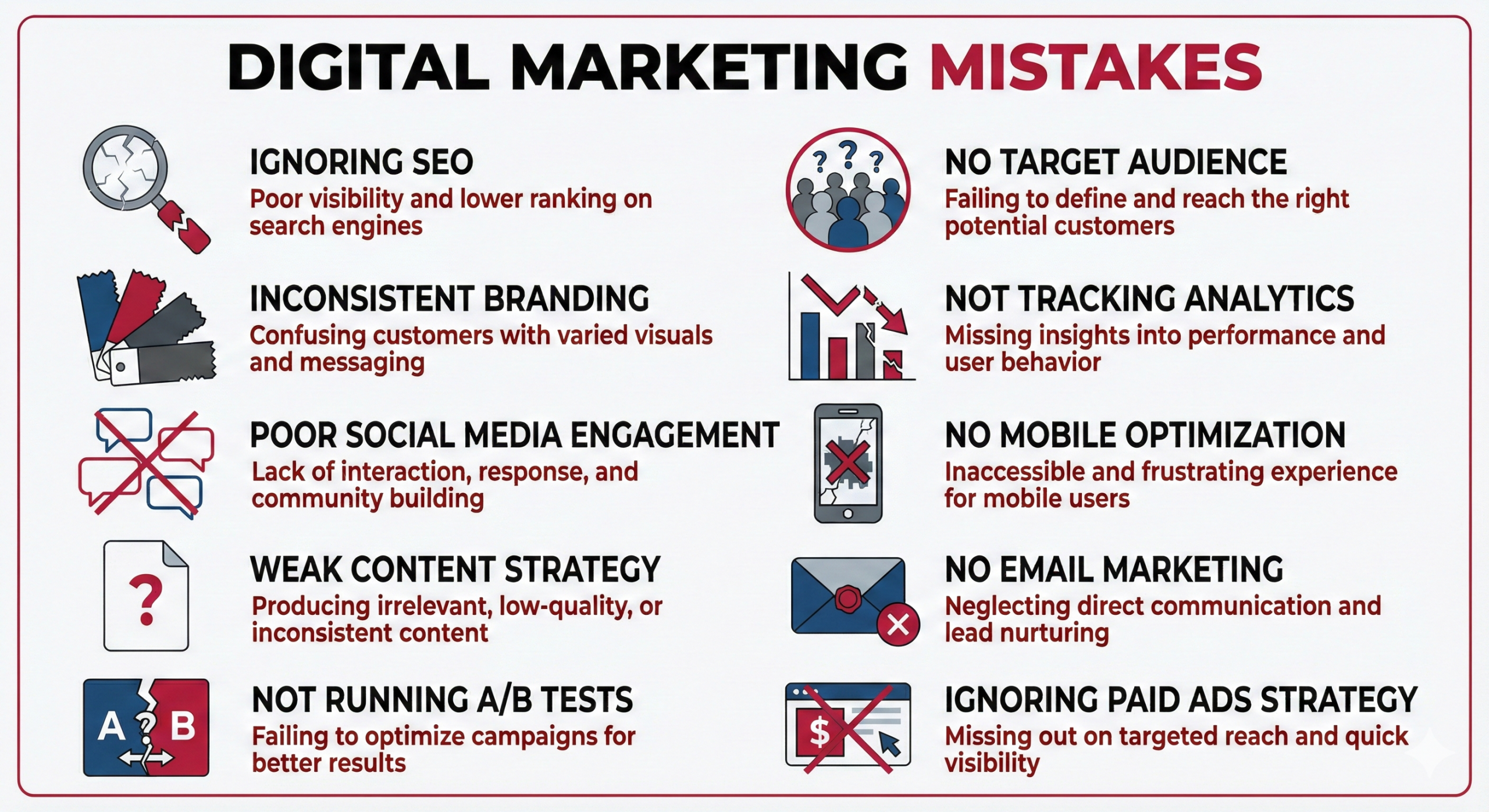
Ignoring Google E-E-A-T in Content Strategy

Most digital marketers focus their attention on keywords without paying enough attention to content. This is one of the biggest digital marketing mistakes to avoid in 2026. Google does not reward content that is written to rank in search engines. Instead, it rewards content that demonstrates true experience and expertise.
Websites that do not reveal their content authors and their credentials to users do not pass Google’s trust test. Similarly, content that does not include true-life examples or proper research does not have any chance of ranking in search engines. In fields like health care or financial services, failure to comply with Google’s E-E-A-T guidelines can bring business growth to a complete halt.
Publishing Content Without Real Experience
Writing about products you’ve never used or services you’ve never tested will definitely raise red flags for your audience. Experience gives you credibility. Without it, you’re writing generic information that doesn’t help the reader.
Failing to Display Author Credentials
It’s suspicious when you can’t find information about the author on the website. Displaying author credentials can help you appear more credible to both the audience and search engines.
Overusing AI Without Human Review

While AI can help you create content faster, relying on it exclusively can get you into trouble. For one, it lacks real-life experience and can contain inaccuracies or outdated information.
Publishing AI Content Without Fact-Checking
One of the biggest pitfalls you should watch out for in 2026 is publishing AI-generated content without fact-checking. The information you use can contain inaccuracies, which can harm your reputation.
Removing the Human Voice from Content
While AI can help you create content, it lacks the human touch. Make sure you add personal anecdotes, explanations, and information to make it more relatable.
Creating Content for People, Not Algorithms
In the old days, some marketers would write articles that contained keywords to increase traffic. However, in 2026, this strategy fails. Google has set new guidelines under Helpful Content that value users first.
Keyword Stuffing
Using too many keywords in an article makes it look like you’re struggling to write. This is bad news with Google.
Thin or Shallow Articles
Writing very short articles that contain little information does not cut it anymore. Google wants in-depth information that answers questions in detail.
Ignoring Website Trust Signals
Trust is everything in online marketing. If your website looks dodgy or confusing, users will leave in no time. Humans make subconscious decisions in under a second to determine if you look trustworthy.
Not Using HTTPS
Google Chrome will pop up a small alert if your website does not use HTTPS. This scares users away. Just like you need to lock your front door before your guests arrive, you need to have HTTPS to keep users safe.
Missing Contact Information
If they cannot find a phone number, email address, or physical address, they will be unsure. A business that does not have clear contact information looks suspicious.
Spreading Misinformation in YMYL Topics
YMYL stands for Your Money or Your Life. This includes health, money, safety, and other topics that Google considers extremely sensitive. If you spread misinformation on these topics, you will harm your users.
Giving Advice Without Expertise
If you give health or money advice without expertise in the field, you will mislead your users. Google expects you to have credible evidence of your expertise.
Not Updating Outdated Information
If you have outdated information on your website, you will mislead your users. If your content looks like it was written in 2018, users will know that you have not updated it.
Not Considering User Experience (UX)
User experience is the way users feel when they use your website. If your website looks confusing and messy, users will not stay on your website.
Slow Website Speed
If your website takes a while to load, users will leave your website. If users have to wait for a few seconds for your website to load, they will not stick around.
Poor Mobile Optimization
Most users use mobile phones to access the internet. If your website looks unattractive on mobile phones, users will not stick around.
Shifting Focus: Traffic vs. Conversions
Marketers often obsess over traffic as if it were a sprint. It’s great to have big numbers, but it’s the actual conversions that pay the bills.
No Clear Next Step
If the user doesn’t know what to do next, they’ll wait. Offering a button, such as “Buy Now” or “Book a Call,” will encourage them to proceed. Clear steps are often more effective than vague suggestions.
Cluttered Checkout
Online businesses lose sales due to long forms and many steps. People get tired of filling out forms. Keeping the checkout process short and simple is a good idea.
Quality of Backlinks
Using backlinks can be good, but not all backlinks are good. Some backlinks will actually harm your website.
Low Quality Link Buying
Getting paid or spam links can be a shortcut, but Google will catch it, and it will harm your website. Be wary of quick fixes, as they often backfire.
For Natural Link Building
Offering useful content will naturally lead to backlinks. It’s a long process, but it’s the safest way.
Not Tracking Analytics
If you don’t use analytics, then you are essentially guessing. Using analytics will show you what works and what doesn’t.
Ignoring Bounce Rate and Engagement
If people are leaving your website after viewing only a single page, then something is wrong. High bounce rates are a sign of poor content or poor design. Monitoring engagement will allow you to fine-tune your website.
Not Measuring Conversions
Clicks are important, but conversions are more important. If you are tracking conversions, then you’ll know which methods are working and which aren’t.
Clickbait Headlines
While clickbait headlines will increase traffic, it will also alienate your audience. If the content doesn’t meet the hype, then people will lose trust in your website.
Breaking User Trust
Users will not trust your website if they feel tricked. Once trust is broken, it’s difficult to regain it.
Rising Bounce Rate
Users will click, visit the website, and then leave. This is a problem, as it sends the wrong signals to the search engines.
Neglecting Brand Reputation Management
In 2026, the importance of online reputation has never been higher. People read reviews before they buy.
Not Responding to Reviews
Not engaging with negative comments looks lazy. Responding to complaints politely is an act of maturity.
Not Building Authority
Building a name takes time. Participate in the conversation and share your thoughts. Authority is developed over time. The more you show up, the more recognition you’ll gain.
Copying Content from Competitors
Copying someone else’s stuff is easy. It takes no skill. It hurts your credibility. Originality is important. It matters to your readers. It matters to you. It matters to your business. So, please, for the love of all things good and holy, write your own stuff. Don’t rip off someone else’s hard work. It’s just not worth it. You’ll end up with a bad reputation. And you’ll have to deal with the duplicate content issues. See below.
Duplicate Content Issues
Duplicate content hurts your rankings. It makes it hard for the search engines to know what to do with you. So, write your own stuff. Don’t rip off someone else’s hard work. It’s just not worth it. You’ll end up with a bad reputation. And you’ll have to deal with the duplicate content issues. See above.
Not Having Unique Value to Share
Not having anything new to share makes you irrelevant. You’ll have no reason to come back. You’ll have no reason to stay. You’ll have no reason to share. So, come up with something new. Come up with something innovative. Come up with something unique.
Not Updating Old Content
Digital marketing is a fast-paced field. Remember how something was a huge success a few years ago but now it’s a total failure? Yeah, it happens.
Outdated SEO Tricks
Using outdated SEO tricks like keyword stuffing will only get you into trouble today. Search engines now want to see natural, human language.
Missing New Trends and Tools
To keep your strategy alive, you need to keep up with the new trends and tools. Don’t skip new tools because your competitors will be using them.
Ignoring Data Privacy Laws
Data privacy laws are becoming stricter all over the world. You should take these laws seriously.
No Privacy Policy
Having a clear privacy policy shows your audience that you are open to their needs. Your audience wants to know how you are using their data.
Misusing Customer Data
Misusing your customers’ data will get you into trouble.
Failing to Build Personal Brand Authority
Personal branding is important in the year 2026. People generally trust people more than companies.
No Public Presence
Experts who contribute their ideas to the public get noticed. Showing up consistently is important.
Hiding behind Anonymous Content
Hiding behind anonymous content will get you nowhere. People want to know you.
Overemphasizing quantity instead of content quality
Having a lot of sub-standard content will weigh your website down. Quality and quantity are not the same.
The risk of burnout in publishing
If you publish every day without a plan, it will exhaust you and disrupt your rhythm.
Shallow content vs. depth
Content that delves deeper into the details performs better than shallow content written in a hurry.
Failure to account for algorithm changes
Google updates its algorithms constantly. If your website doesn’t, it will lose rankings in no time.
Failure to keep up with SEO news
If you are in the know, you will be able to react quickly. SEO news is the early warning system.
Failure to have a flexible plan
Having a stiff, inflexible plan will not cut it in the long run.
Some final thoughts on avoiding digital marketing pitfalls in 2026
The way to avoid digital marketing pitfalls in 2026 is quality, transparency, and delivering value to users. Google’s E-E-A-T standards are here to stay and will continue to be used as a benchmark for quality content in the long run. By showing experience, expertise, authority, and trust, businesses can ensure their rankings and reputation remain safe. Ultimately, digital marketing success comes down to responsibility and learning.